

You’re standing in the middle of a cluttered office suite on Arden Way, staring at 47 cubicles, a server rack that hasn’t been powered on since 2019, and a breakroom refrigerator nobody wants to open. You pull up a junk removal website and wonder: Is this the same service that cleared out my garage last summer—or do I need something completely different?
The short answer: commercial junk removal and residential junk removal share the same basic concept—hauling away stuff you don’t want—but the similarities pretty much end there. The scale, scheduling, pricing, compliance requirements, and logistics are different enough that choosing the wrong type of service can cost you time, money, and serious headaches.
In this guide, we’ll break down the 8 key differences between commercial and residential junk removal so you know exactly what to expect whether you’re clearing out a home, an office, a warehouse, or a retail space in the Sacramento area. By the end, you’ll understand which service fits your situation—and why it matters.
🔑 Key Takeaways
- Commercial junk removal handles larger volumes, stricter compliance needs, and complex logistics like loading docks and freight elevators.
- Residential junk removal is typically smaller-scale, more flexible on timing, and focused on household items.
- Pricing models differ significantly—residential is usually volume-based, while commercial projects often use project-based or contract pricing.
- Businesses face additional regulatory requirements including data destruction, OSHA compliance, and hazardous material handling.
- A reputable junk removal company like Take Care Junk can handle both—but knowing the differences helps you get accurate quotes and better service.
1. Scale and Volume: One Room vs. an Entire Building
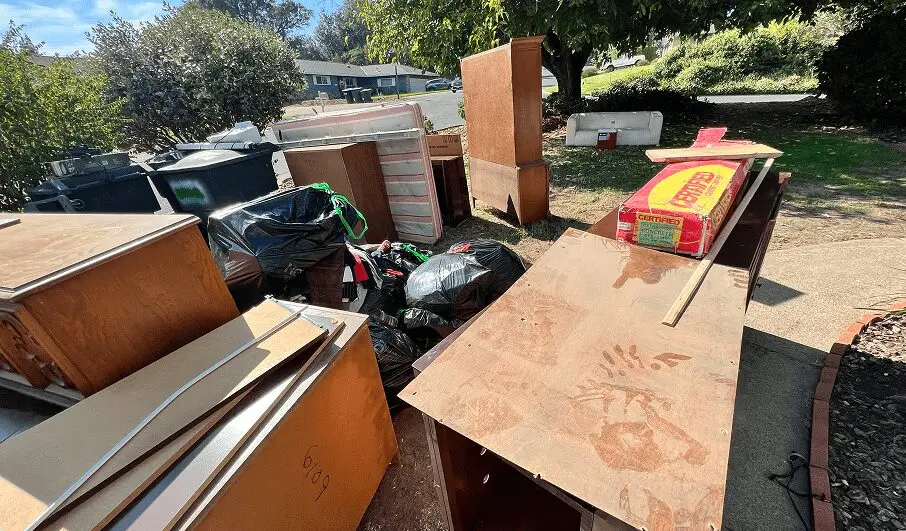
The most obvious difference between commercial and residential junk removal is sheer scale. A typical residential job might involve clearing out a garage, hauling away an old couch and mattress, or handling a single-room estate cleanout. Most residential jobs fill anywhere from a quarter-truck to two full truck loads.
Commercial junk removal? That’s a different animal entirely. Think:
- Full office cleanouts with dozens of desks, chairs, and filing cabinets
- Retail store closures with shelving units, display cases, and point-of-sale equipment
- Warehouse clear-outs involving pallets, racking systems, and industrial equipment
- Restaurant teardowns with commercial kitchen appliances and walk-in cooler components
A single commercial job in downtown Sacramento or along the Power Inn Road industrial corridor can generate 10 to 50 times the volume of a typical residential cleanout. That means commercial hauling services need larger crews, multiple trucks, and sometimes heavy equipment like dollies, pallet jacks, or even forklifts to get the job done efficiently.
💡 Did You Know? The average Sacramento office generates roughly 4.4 pounds of waste per employee per day, according to CalRecycle estimates. When a company with 100 employees relocates or downsizes, the accumulated junk from furniture, old files, and outdated equipment can fill multiple 20-cubic-yard trucks.
For residential customers, most junk removal companies—including Take Care Junk—can provide a quick visual estimate and get the job done in a single visit. Commercial projects typically require a walkthrough and detailed scope assessment before the crew even shows up. [INTERNAL LINK: /commercial-junk-removal/]
2. Timing and Scheduling: Business Hours vs. Anytime
When you’re clearing junk out of your home, you’ve got flexibility. Saturday morning? No problem. Tuesday at 2 PM while you’re working from home? Sure. Residential junk removal scheduling revolves around your convenience.
Commercial junk removal scheduling revolves around minimizing disruption to business operations—and that changes everything.
Here’s what commercial scheduling often looks like:
- After-hours and weekend work: Many Sacramento businesses need junk removed outside of operating hours. A busy dental office on J Street can’t have crews hauling filing cabinets through the waiting room while patients are being seen.
- Phased scheduling: Large commercial projects are often broken into phases. Maybe you clear the third floor this week and the second floor next week to keep part of the building operational.
- Tight deadlines: Lease expirations don’t negotiate. If your commercial lease at a Natomas business park ends on the 30th, every piece of junk needs to be gone by the 29th—no exceptions.
- Coordination with other contractors: Commercial cleanouts often happen alongside renovation crews, IT teams doing equipment decommissioning, or property management companies doing walkthroughs.
Residential customers typically book a same-day or next-day pickup window. Commercial clients often schedule days or weeks in advance, with a detailed timeline and project plan.
🔧 Pro Tip: If you’re planning a commercial cleanout in Sacramento, start getting quotes at least 2–3 weeks before your target date—especially during the busy summer months when office relocations peak. This gives your junk removal team time to do a proper walkthrough and allocate the right crew size.
[INTERNAL LINK: /contact/]
3. Pricing Models: Volume-Based vs. Project-Based
How you pay for junk removal depends heavily on whether it’s a residential or commercial job—and understanding the pricing model upfront prevents sticker shock.
| Feature | Residential Junk Removal | Commercial Junk Removal |
| Pricing Model | Volume-based (how much truck space you fill) | Project-based, hourly, or contract pricing |
| Typical Cost Range | $150–$700+ per load | $500–$5,000+ per project |
| Estimates | Quick visual or photo-based | On-site walkthrough required |
| Discounts | Seasonal promotions, senior/military | Volume discounts, recurring service contracts |
| Extra Fees | Stairs, heavy items, hazmat | After-hours labor, compliance disposal, equipment |
Residential pricing is straightforward. Most Sacramento junk removal companies, Take Care Junk included, charge based on how much space your items take up in the truck. Quarter load, half load, full load—done.
Commercial pricing is more complex because there are more variables: the volume of material, the type of items (e-waste and hazmat cost more to dispose of), access difficulty, labor hours required, timing constraints, and any compliance or documentation needs. A business junk removal project might involve a flat project fee, hourly rates for labor, or a recurring service contract for ongoing waste management.
For Sacramento businesses, requesting a detailed written estimate with line items is standard practice for commercial projects. Don’t settle for a ballpark number over the phone. [INTERNAL LINK: /pricing/]
4. Types of Items: Office Equipment vs. Household Goods
What’s actually getting hauled away is fundamentally different between commercial and residential junk removal, and it affects everything from truck configuration to disposal methods.
Common residential items: – Furniture (sofas, beds, dressers, dining sets) – Appliances (refrigerators, washers, dryers) – Yard waste and outdoor items (hot tubs, sheds, play structures) – Garage clutter (tools, bikes, storage bins) – Mattresses, box springs, and old carpet – General household junk and boxes
Common commercial items: – Office furniture (cubicles, executive desks, conference tables, ergonomic chairs) – IT equipment (servers, monitors, printers, networking gear, phone systems) – Retail fixtures (shelving, mannequins, display cases, signage) – Medical or dental equipment – Industrial machinery and warehouse racking – Restaurant equipment (ovens, fryers, walk-in coolers, hood systems)
The distinction matters because different items require different handling and disposal channels. An old couch from a Carmichael home goes to the Sacramento County Kiefer Landfill or gets donated to a local thrift store. A rack of servers from a Folsom tech company needs certified data destruction before disposal. A walk-in cooler from a restaurant on Broadway likely contains refrigerants that require EPA-compliant handling.
💡 Did You Know? California’s SB 20 (Electronic Waste Recycling Act) requires that certain electronic devices be recycled through state-approved recyclers. Businesses disposing of large quantities of e-waste in Sacramento need to ensure their junk removal company follows these regulations—or risk fines. Take Care Junk partners with certified e-waste recyclers to keep your business compliant. [INTERNAL LINK: /e-waste-disposal/]
Need help clearing out your office or commercial space? Take Care Junk handles both residential and business junk removal across Sacramento and surrounding areas. [INTERNAL LINK: /contact/] to get a free estimate today.
5. Compliance Requirements: Data Destruction, OSHA, and Hazmat
This is where the gap between residential and commercial junk removal gets really wide. Homeowners generally don’t need to worry about regulatory compliance when tossing out an old bookshelf. Businesses? That’s a completely different story.
Key compliance areas for commercial junk removal:
- Data destruction: Under California’s data privacy laws (including the CCPA/CPRA), businesses are responsible for ensuring that sensitive data on hard drives, file servers, and even paper documents is properly destroyed. A reputable commercial hauling service will provide certificates of destruction for IT equipment and confidential files.
- OSHA compliance: Commercial job sites—especially warehouses, industrial facilities, and construction sites—have occupational safety requirements. Junk removal crews working in these environments need proper PPE, fall protection, and hazardous material handling training.
- Hazardous materials: Commercial properties often have materials that require special disposal: fluorescent lighting tubes (mercury), batteries, chemical solvents, medical waste, or asbestos-containing materials in older Sacramento buildings. These can’t go in a standard truck and must be routed through licensed hazmat disposal facilities.
- AB 1383 compliance: California’s SB 1383 regulations require businesses to separate and divert organic waste. If your commercial cleanout includes food waste or compostable materials, your junk removal company needs to handle this properly.
Residential junk removal compliance is simpler—mainly involving proper disposal of items like refrigerators (Freon removal), mattresses (California mattress recycling fee), and paint or household chemicals through Sacramento County’s Household Hazardous Waste facility.
🔧 Pro Tip: When hiring a commercial junk removal company in Sacramento, always ask: “Can you provide documentation of proper disposal and data destruction?” If they hesitate or say no, that’s a red flag. Take Care Junk provides disposal documentation for all commercial projects. [INTERNAL LINK: /commercial-junk-removal/]
6. Insurance and Liability: Higher Stakes for Commercial Projects
Both residential and commercial junk removal companies need to carry insurance—but the level and type of coverage differ significantly.
| Insurance Type | Residential Jobs | Commercial Jobs |
| General Liability | Standard ($1M typical) | Higher limits ($2M–$5M+ often required) |
| Workers’ Compensation | Required | Required (often verified by client) |
| Commercial Auto | Standard | Higher coverage for larger vehicles |
| Professional Liability | Rarely needed | Often required for data destruction, compliance work |
| Property Damage Coverage | Standard | Higher limits for expensive commercial spaces |
When a junk removal crew is working in your home, the liability exposure is relatively contained. A scratch on the hallway wall or a ding on the front door is unfortunate but manageable.
When that same crew is working in a Class A office building on Capitol Mall or a medical facility in Roseville, the stakes go way up. Damage to commercial flooring, elevator interiors, fire suppression systems, or sensitive equipment can cost tens of thousands of dollars. Many commercial property managers and building owners require proof of specific insurance levels before they’ll even grant access.
Sacramento businesses should always verify that their junk removal company carries adequate commercial insurance and is willing to provide a certificate of insurance (COI) naming your property as an additional insured. Take Care Junk is fully licensed and insured for both residential and commercial projects across the Sacramento region. [INTERNAL LINK: /about/]
7. Service Frequency: Recurring Contracts vs. One-Time Pickups
Here’s a difference many people don’t think about until they need it: how often you need junk removal service.
Residential junk removal is almost always a one-time event. You’re moving, downsizing, renovating, handling an estate cleanout, or just finally tackling that garage. You call, the crew shows up, and you’re done. Maybe you call again in a few years.
Commercial junk removal often involves recurring service agreements. Businesses generate waste continuously, and many commercial clients in Sacramento set up:
- Weekly or biweekly pickups for retail stores, restaurants, or medical offices
- Monthly cleanouts for property management companies handling multiple rental units
- Quarterly IT equipment disposal for tech companies or government agencies
- Project-based recurring work during multi-phase renovations or build-outs
- On-call agreements with guaranteed response times for emergency cleanouts
Recurring commercial contracts often come with volume discounts and priority scheduling—something that makes a big difference when you need a crew on-site by 6 AM before your Elk Grove warehouse opens for the day.
💡 Did You Know? Many Sacramento property management companies handling apartment turnovers need junk removal crews available on short notice multiple times per month. A recurring service contract with a reliable company like Take Care Junk ensures you’re never scrambling to find availability during peak turnover season (typically July–September in the Sacramento rental market).
Managing ongoing junk removal for your business? Take Care Junk offers flexible commercial contracts with priority scheduling. [INTERNAL LINK: /contact/] to discuss your needs.
8. Access Challenges: Loading Docks, Elevators, and Security Protocols
The last major difference—and one that directly impacts cost and timeline—is how crews physically access the junk.
At a residential property, access is usually straightforward: walk through the front door, the garage, or the side gate. Maybe there’s a staircase or a narrow hallway to navigate. Occasionally you’ll deal with a tricky situation like a hot tub in a fenced backyard with no gate access, but these are the exceptions.
Commercial properties present a whole different set of access challenges:
- Freight elevators and loading docks: High-rise office buildings in downtown Sacramento require coordination with building management for freight elevator reservations and loading dock time slots. Miss your window, and your crew might be standing around for hours.
- Security and access control: Many commercial buildings require advance security clearance for crew members, background checks, or escort requirements. Government buildings and medical facilities in Sacramento often have the strictest protocols.
- Parking and staging: Where do you park two or three junk removal trucks at a commercial property in Midtown Sacramento? Street parking restrictions, fire lane regulations, and limited lot space all factor in.
- Multi-floor logistics: Removing 200 cubicles from the 8th floor of a building takes a completely different approach than hauling a couch out of a single-story home in Fair Oaks.
- Tenant coordination: In multi-tenant commercial buildings, junk removal has to be scheduled around other businesses. You can’t block the shared hallway with filing cabinets during another tenant’s business hours.
A residential job might take 30 minutes to 2 hours. A complex commercial job at a multi-story Sacramento building can take multiple days just because of access logistics.
🔧 Pro Tip: Before your commercial junk removal walkthrough, gather key details for your provider: freight elevator dimensions and availability, loading dock hours, security requirements, and any building management rules. This helps your junk removal company plan accurately and avoid costly delays. [INTERNAL LINK: /commercial-junk-removal/]
The Bottom Line: Which Service Do You Need?
Whether you’re clearing out a three-bedroom home in Citrus Heights or decommissioning an entire office floor in downtown Sacramento, the type of junk removal service you need depends on scale, compliance, logistics, and frequency.
Here’s the quick decision guide:
| You Need Residential Junk Removal If… | You Need Commercial Junk Removal If… |
| Clearing a home, garage, attic, or yard | Clearing an office, warehouse, retail space, or industrial site |
| Items are standard household goods | Items include IT equipment, commercial fixtures, or regulated materials |
| One-time or occasional service | One-time project or recurring service needed |
| Flexible timing works | Specific scheduling around business operations required |
| No special compliance needs | Data destruction, OSHA, or hazmat compliance needed |
The good news? You don’t need to hire two different companies. Take Care Junk handles both residential and commercial junk removal across Sacramento, Elk Grove, Folsom, Roseville, West Sacramento, Rancho Cordova, and surrounding communities. We bring the right crew, the right equipment, and the right expertise—whether it’s a single couch or an entire commercial building.
Ready to get started? Call Take Care Junk today for a free, no-obligation estimate. We offer same-day service for residential pickups and detailed project planning for commercial cleanouts across Sacramento and surrounding areas. [INTERNAL LINK: /contact/]
Frequently Asked Questions
Can the same company handle both commercial and residential junk removal?
Yes—but not every company is equipped for both. Look for a junk removal provider with commercial insurance, compliance capabilities, and experience with large-scale projects. Take Care Junk serves both residential and commercial clients throughout the Sacramento area with dedicated crews for each. [INTERNAL LINK: /services/]
How much does commercial junk removal cost in Sacramento?
Commercial junk removal pricing varies widely based on volume, item type, access difficulty, and compliance requirements. Small office cleanouts might start around $500–$1,500, while full building cleanouts can run $3,000–$10,000+. The best approach is to schedule an on-site walkthrough for an accurate project-based quote.
Do I need to sort items before a commercial junk removal?
Not necessarily, but it helps. Separating items into categories—donate, recycle, dispose, and shred—can speed up the process and potentially reduce costs. Take Care Junk crews can also handle sorting on-site as part of the service. We donate and recycle a good share of the items we collect, keeping usable goods out of Sacramento landfills.
How far in advance should I schedule a commercial cleanout?
For large commercial projects in Sacramento, we recommend scheduling 2–4 weeks in advance. This allows time for a proper walkthrough, crew and equipment planning, and coordination with building management. Smaller commercial jobs can often be scheduled within a few days. [INTERNAL LINK: /contact/]
What happens to old office electronics and IT equipment?
Responsible commercial junk removal companies route e-waste through certified recyclers in compliance with California’s Electronic Waste Recycling Act (SB 20). Hard drives and data-containing devices should be physically destroyed or wiped with documented chain of custody. Take Care Junk works with certified e-waste facilities to ensure full compliance. [INTERNAL LINK: /e-waste-disposal/]
Is commercial junk removal available on weekends and after hours in Sacramento?
Yes. Many commercial junk removal projects in Sacramento are specifically scheduled for evenings, weekends, or holidays to minimize disruption to business operations. Take Care Junk offers flexible scheduling including after-hours service for commercial clients.
)