

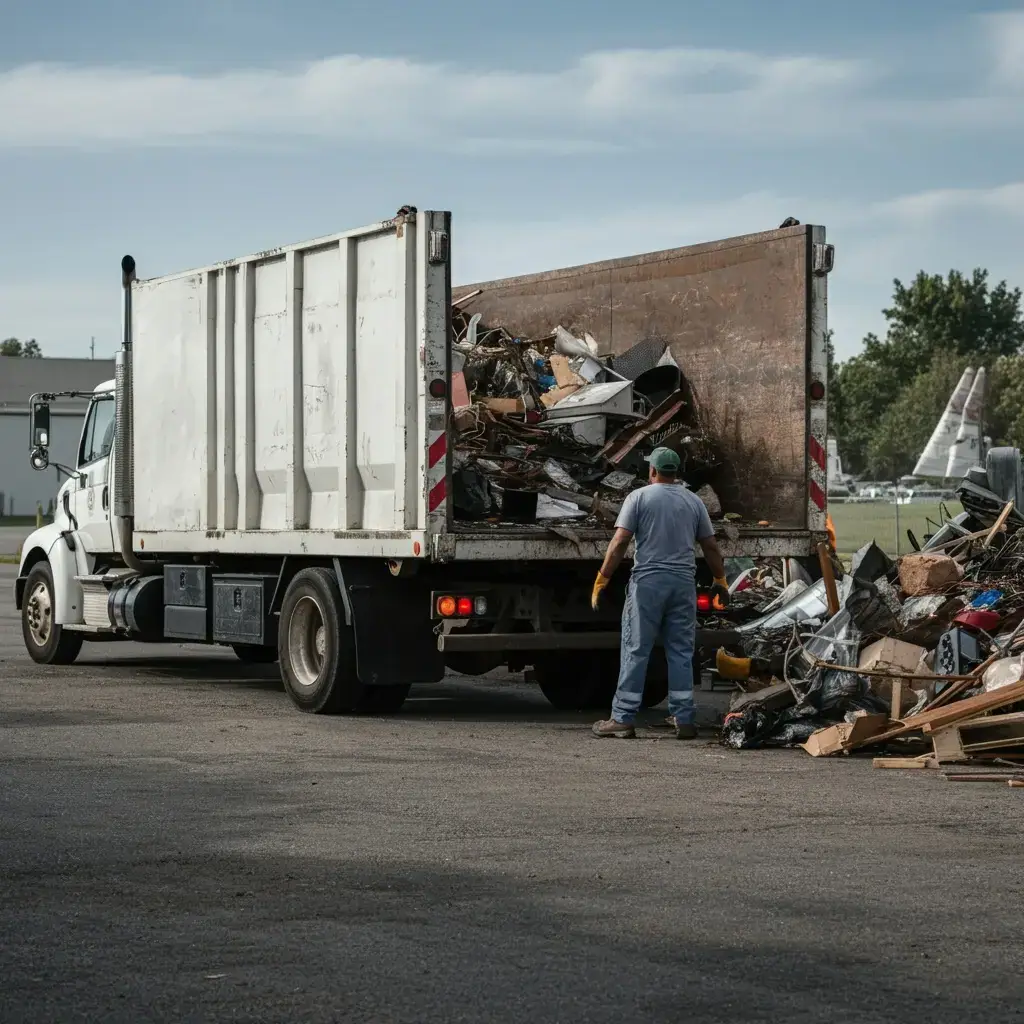
It is collection morning in Stanford Ranch. The gray cart is at the curb, lid propped open by a broken floor lamp, with a bag of leaves leaning on it and a half-full paint can tucked behind. The truck comes, takes nothing, and leaves a tag on the handle. That tag is what most of Rocklin’s rules are really about: what the automated arm will and will not pick up.
Here is the whole Rocklin waste disposal system in one place: what goes in each cart, where to put the carts, how to use the free bulky pickups, where hazardous waste and e-waste actually go, and what it costs when someone dumps a couch on a Quarry Park trail instead. For the broader picture, see our guide to waste disposal rules across the region. If a cleanout is bigger than the carts, professional junk removal services are the last section.
The Three-Cart System: The Foundation of Local Disposal
Rocklin’s curbside service is run by Recology (formerly Auburn Placer Disposal Service). Three carts, one truck each, and the arm only grabs what it is supposed to. For a garage or whole-house clearout that will not fit, residents book residential junk removal services instead of filling the carts for a month.
The Gray Cart: Trash and Landfill Waste
Gray (black on older bins) is the landfill cart, for what cannot be recycled or composted:
- Soft plastics: plastic bags, shrink wrap, bubble wrap, chip bags. They tangle the recycling machinery.
- Hygiene products: diapers, sanitary products, wet wipes, cotton swabs.
- Pet waste: bagged dog waste and kitty litter.
- Broken ceramics: plates, mugs, mirrors.
- Mixed materials: juice pouches, toothpaste tubes, coated take-out containers.
- Polystyrene foam: cups, packing peanuts, meat trays.
Never in the gray cart: hazardous waste, batteries or electronics. Batteries start fires in collection trucks, and all three are illegal in a landfill.
The Blue Cart: Recycling
Blue is single-stream recycling, so paper, plastic, metal and glass go in together. Single-stream does not mean anything goes: one dirty or wrong item can contaminate a whole truckload and send it to the landfill.
- Paper: newspaper, junk mail, magazines, office paper, envelopes.
- Cardboard: flattened corrugated boxes and paperboard like cereal boxes.
- Plastics: rigid containers marked #1 through #7 (bottles, jugs, tubs). Leave the caps on.
- Metals: aluminum cans, steel and tin cans, clean foil.
- Glass: bottles and jars, any color.
Three rules that cover most mistakes:
- Clean and dry. A jar still half full of peanut butter is trash, not recycling.
- No bags. Recyclables go in loose. Garbage bags jam the sorting gears at the facility.
- When in doubt, throw it out. Guessing (“wishcycling”) does more harm than the one item it might save.
The Green Cart: Organic Waste
Senate Bill 1383 turned the green cart from a yard-waste cart into an organics cart. Everything in it becomes compost and mulch instead of landfill methane.
- Yard trimmings: grass, leaves, weeds, flowers, branches under 4 inches in diameter.
- Food scraps: all of it. Fruit, vegetables, bread, pasta, meat, bones, dairy, eggshells.
- Food-soiled paper: coffee filters, tea bags, greasy pizza boxes, napkins and paper towels (as long as no chemical cleaner is on them).
Layer food scraps between yard trimmings to keep the cart cleaner. Wrap scraps in newspaper or a paper bag if you like, but no plastic bags, including ones labeled “biodegradable” or “compostable,” unless Recology has specifically approved them. Paper is the safe choice.
Curbside Collection Etiquette and Rules
Filling the carts correctly is half the job. The automated arm needs the cart in the right place, or it drives past.
Placement Guidelines
- Timing: carts at the curb by 5:00 AM on collection day, or the night before. Bring them in by that evening. Carts left out for days are a code violation.
- Spacing: 2 to 3 feet between carts so the arm can grab one without tipping the next.
- Clearance: at least 6 feet from parked cars, mailboxes, basketball hoops and trees.
- Position: wheels against the curb, lid opening toward the street.
- Lids closed: an overfilled cart spills when lifted and blows litter down the street, so the driver skips it.
If the carts are full every single week, order an extra cart from Recology for a fee. If it is one big purge rather than a weekly problem, a private hauler is cheaper than a year of extra cart charges.
Bulky Item Pickup: Managing Large Waste
An old mattress, a dead washer, a sagging sofa: none of it fits a cart, and none of it can sit at the curb on a regular trash day. Rocklin gives residents a bulky pickup program for exactly these, and professional junk hauling services cover what it does not.
The On-Call Pickup Program
Most residents get two free scheduled pickups a year (confirm with Recology; it can vary by zone). Each pickup takes up to four cubic yards at the curb, about two pickup truck beds.
Accepted: furniture (couches, chairs, tables), mattresses and box springs, appliances (washers, dryers), e-waste (TVs, computers), tires (a limit usually applies), and bagged trash or boxed small items.
Not accepted: construction and demolition debris (concrete, dirt, rock), hazardous waste (paint, oil, chemicals), and car bodies or large car parts.
When to Hire Professional Junk Removal
The free pickup has three limits: you carry everything to the curb yourself, you get four cubic yards, and you get two dates a year. An estate cleanout in Whitney Ranch or a garage that has not seen a car since 2019 blows past all three. That is when a crew that offers furniture removal services makes sense: we walk in, lift, load and sweep. For a deadline, same-day junk removal skips the wait for a city date entirely, and it covers the items the city will not take and the volume over the 4-cubic-yard line.
“Quick response time, and was able to come the same day to pick up a medium-sized load. Was fairly priced, professional, and great with communication.”
Caitlin S., YelpHazardous Waste: The “Do Not Touch” List
The hard line in the recycling rules in Rocklin is what never goes in any cart. Hazardous waste hurts sanitation workers and poisons groundwater, and no hauler, including us, will take it.
Identifying Household Hazardous Waste (HHW)
HHW is anything flammable, corrosive, toxic or reactive:
- Paints, varnishes and stains
- Motor oil, antifreeze and oil filters
- Pesticides, herbicides and fertilizers
- Household cleaners (bleach, ammonia, drain openers)
- Pool chemicals
- Propane tanks, camping size or BBQ size
- Batteries, household and automotive
- Fluorescent bulbs and tubes
Where to Take HHW
Never down the drain or the storm gutter. Rocklin residents take HHW to the Western Placer Waste Management Authority (WPWMA) facility on Athens Avenue in Lincoln. Drop-off is free for Placer County residents, with daily limits. Keep everything in its original container if you can, make sure nothing leaks, and carry it in the trunk, not the cab.
Electronic Waste (E-Waste)
Old electronics carry lead and mercury. The bulky pickup takes some e-waste, and WPWMA takes it free, so the metals get recovered and the toxic parts are handled safely. A big pile from an office cleanout should go straight to an e-waste recycler. A few electronics mixed into a regular pickup are fine with us; we drop them at an e-waste recycler on the way.
Construction and Demolition (C&D) Debris
Lumber, drywall, concrete, asphalt, brick and roofing shingles from a remodel are C&D debris, and they have their own rules.
C&D Recycling Requirements
California’s CalGreen code requires a set share of construction waste to be diverted from the landfill. On a permitted project you may have to file a Waste Management Plan with the city showing how you recycled the debris.
Disposal Options for C&D
- Rent a debris box: the standard move for a big job. Use a franchised hauler authorized to operate in Rocklin.
- Self-haul: drive it to the WPWMA landfill and pay the gate fee. Mixed loads that need sorting cost more.
- Professional hauling: mixed demolition debris is a job for a licensed C&D hauler or a debris dumpster. We can take a single-material load (metal only, concrete only or clean wood only) but we do not sort mixed construction debris.
Illegal Dumping: Costs and Consequences
Leaving trash on an empty lot, a roadside or in someone else’s commercial dumpster is illegal dumping. In Rocklin it is treated as a serious offense: it blights the landscape, hurts wildlife and costs taxpayers to clean up.
Penalties
Fines run from hundreds to thousands of dollars depending on how much was dumped and how often.
Reporting
If you see it happen, report it to the Rocklin Police Department or through the city’s code enforcement channels. A license plate number or a description is what makes a case. If you are the one with a pile, every legal route above is cheaper than the fine: the carts, the bulky pickup, WPWMA or a licensed hauler. Neighboring cities have made enforcement a regional priority too.
Special Recycling Programs and Tips
A few programs handle the items people most often get wrong.
Mattress Recycling
Over 75 percent of a mattress (steel, foam, wood) can be recycled. Under California’s “Bye Bye Mattress” program, residents recycle mattresses free at participating sites, including WPWMA. And when a retailer delivers a new mattress, state law requires them to offer to take the old one at no extra charge.
PaintCare
Leftover house paint, stain and varnish can be dropped free at participating hardware stores and paint shops in Rocklin through PaintCare. Easier than a trip to Lincoln for three cans.
Sharps Disposal
Loose needles and lancets never go in the trash. Residents can pick up approved sharps containers at designated locations and return them full. Check local pharmacies or WPWMA for current pickup points.
Medication Disposal
Do not flush old prescriptions. Rocklin police stations and some pharmacies have secure drop boxes for expired or unwanted medication.
Tips for Reducing Waste in Rocklin
The cart you do not fill is the cheapest one to manage.
- Shop smart: buy in bulk at Rocklin’s warehouse stores to cut packaging, and bring reusable bags and produce bags.
- Donate: before furniture, clothing or housewares go in a pile, try a local thrift store or charity. Several in the Rocklin and Roseville area will pick up large donations.
- Repair: Rocklin has shoe, electronics and upholstery repair shops. A fixed item is one the landfill never sees.
- Grasscycle: leave clippings on the lawn. They break down in days, feed the soil and free up green cart space.
The Role of Professional Services in Waste Management
The carts handle an ordinary week. A move, a remodel or a serious spring clean does not fit a week, and a hauler fills the gap between the curb and the landfill. We run Take Care Junk pickups in Rocklin regularly, we know which transfer stations sort for recycling and which charities take what, and we donate what’s usable and recycle what we can.
Businesses lean on this more than homeowners. Office furniture upgrades, old fixtures and warehouse clearouts never fit a dumpster enclosure, which is why Rocklin companies use commercial junk removal services to keep the back lot clear. Professional hauling companies serve businesses across the greater Sacramento region the same way.
Seasonal Waste Guidelines
Two times a year the normal routine changes.
Leaf Season
In fall the green cart cannot keep up. The city typically posts extra guidance or pickup options for peak leaf season. Do not blow leaves into the street or the storm drain; that is how streets flood in the first big rain and how leaf litter ends up in the creeks.
Holiday Tree Recycling
After the holidays, trees go curbside (cut into sections) on set dates or to designated community parks. They are chipped into mulch for city parks.
Connecting with the Region
Rocklin shares WPWMA with its neighbors, so the rules here match the rules across Placer County closely, and the recycling and hazardous waste principles carry into Sacramento County too. Moving between cities, or running a business across both counties, rarely means relearning the system.
Conclusion: A Shared Responsibility
Following the Rocklin waste disposal & recycling rules comes down to a few habits: sort the three carts, place them where the arm can reach, take the hazardous stuff to Lincoln, and book the bulky pickup before the pile grows. When the carts and the two free pickups are not enough, professional hauling services take the rest, and your street stays the kind people move to Rocklin for.


