


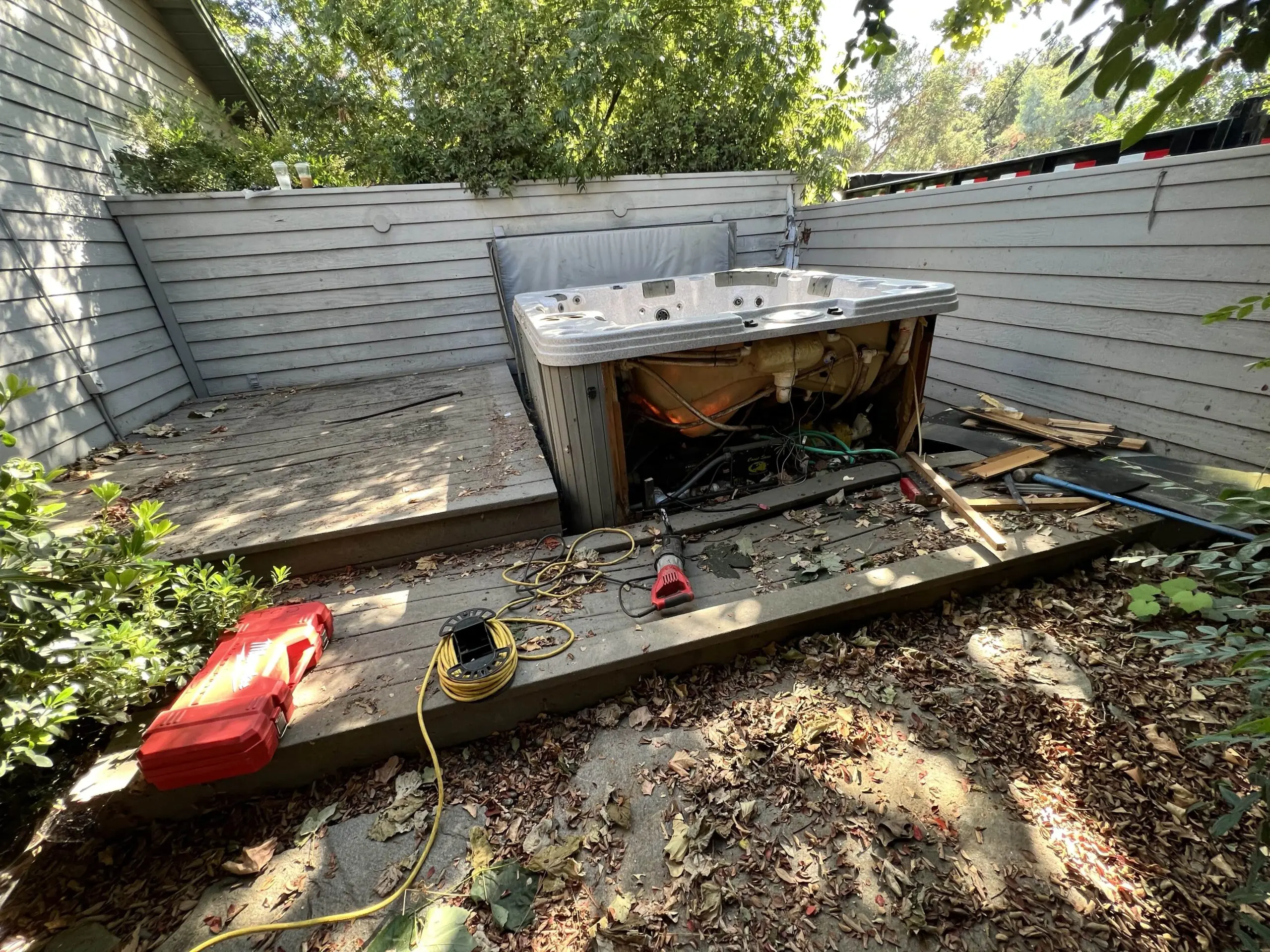
That hot tub in your backyard seemed like a great idea ten years ago. Now it’s cracked, full of standing water, and the only thing soaking in it is a family of mosquitoes. Sound familiar? You’re definitely not alone — hot tub removal in Sacramento is one of the most common calls we get at Take Care Junk, especially from homeowners in Folsom, Fair Oaks, Granite Bay, and El Dorado Hills where backyard spas are practically a neighborhood staple.
Whether your spa finally gave up the ghost or you’re reclaiming your patio for something better, getting rid of a hot tub is more complicated than most people expect. It’s not like tossing out an old couch. We’re talking about a 500- to 900-pound appliance wired into your electrical panel, plumbed into your water line, and possibly bolted onto your deck.
This guide walks you through everything you need to know before tackling hot tub disposal in Sacramento — from electrical safety and cost breakdowns to what actually happens to all that acrylic, wood, and foam after it leaves your yard.
Key Takeaways
- Hot tubs weigh 500–900 lbs and cannot be placed curbside for regular trash pickup
- You’ll need a licensed electrician to disconnect power before any removal work begins
- Professional hot tub removal in Sacramento typically costs $300–$600+ depending on size, location, and access
- Most hot tub materials — acrylic, wood, metal, and wiring — can be recycled or repurposed
- A pro crew can usually complete the entire job in 2–4 hours
1. You Can’t Just Put a Hot Tub on the Curb
Let’s get this one out of the way first: Sacramento County Waste Management will not pick up a hot tub with your regular trash or bulk pickup. It doesn’t matter if you break it into pieces and stack it neatly — hot tubs are classified as oversized items that contain mixed materials (fiberglass, acrylic, treated wood, foam insulation, electrical components), and they don’t fit into the standard residential waste stream.
If you leave a hot tub or spa parts on the curb in neighborhoods like Carmichael, Citrus Heights, or Rancho Cordova, you could face an illegal dumping citation from Sacramento County Code Enforcement. Fines can range from a few hundred dollars on a first offense to significantly more for repeat violations.
Your realistic disposal options are:
- Hire a professional junk removal company like Take Care Junk for full-service removal [INTERNAL LINK: /hot-tub-removal/]
- Rent a dumpster and do the demolition yourself (more on that in item #6)
- Haul it to the Sacramento County Landfill at Kiefer Landfill off Kiefer Blvd — but you’ll need a truck and trailer rated for the weight
💡 Did You Know? Sacramento County’s Kiefer Landfill charges by weight for construction and demolition debris. A typical hot tub disposal runs roughly $40–$80 in dump fees alone — and that’s before you factor in trailer rental and your entire Saturday.
2. Hot Tubs Are Seriously Heavy (500–900 Pounds)
One of the biggest surprises for homeowners trying to figure out how to get rid of a hot tub is just how much these things weigh. An empty standard 4–6 person spa weighs between 500 and 900 pounds. Larger 7–8 person models or older wooden barrel-style tubs can tip the scales even higher.
Here’s a rough weight breakdown by component:
| Component | Approximate Weight |
| Acrylic/fiberglass shell | 100–200 lbs |
| Wooden cabinet & frame | 150–300 lbs |
| Foam insulation | 50–100 lbs |
| Pumps, heater, & plumbing | 75–150 lbs |
| Steel or PVC frame | 50–150 lbs |
That’s why hot tub demolition almost always requires cutting the tub into manageable sections using a reciprocating saw (Sawzall) before moving anything. Trying to lift and carry a full hot tub through a side yard gate is a recipe for back injuries, property damage, or both.
For homes in hilly neighborhoods like El Dorado Hills and Granite Bay, where backyards often sit below grade with limited access, the weight and terrain combination makes professional removal especially worthwhile.
🔧 Pro Tip: If you’re getting quotes for jacuzzi removal near you, always tell the company the approximate size (person capacity), location in the yard, and whether there are stairs, slopes, or narrow gates. These details directly affect the price and crew size needed.
3. Electrical Disconnection Comes First — Always
This is the safety item on the list, and it’s non-negotiable. Every hot tub is hardwired into a dedicated 220–240 volt circuit with its own breaker and often a GFCI disconnect box mounted within sight of the tub. You cannot simply unplug a hot tub like a toaster.
Before anyone touches the spa with a saw or pry bar, that electrical connection needs to be properly disconnected by a licensed electrician. In California, performing your own electrical work on a hardwired 240V circuit without a permit violates state and local building codes. More importantly, cutting into a live hot tub can cause serious electrocution injuries.
What to expect from the electrical disconnection:
- Cost: Most Sacramento-area electricians charge $100–$200 for a straightforward hot tub disconnect
- Time: Usually takes 30–60 minutes
- What they do: Turn off the dedicated breaker, disconnect and cap the wiring at the disconnect box or sub-panel, and verify the circuit is dead
- Permits: Generally not required for a simple disconnection, but check with Sacramento County Building Permits if you’re unsure
Schedule your electrician before your removal date. At Take Care Junk, we ask that the electrical is already disconnected when our crew arrives so we can get straight to work safely. [INTERNAL LINK: /hot-tub-removal/]
Need help getting rid of your old hot tub? Take Care Junk handles the heavy lifting — literally. [INTERNAL LINK: /contact/] to get a free estimate for hot tub removal in Sacramento and surrounding areas.
4. Don’t Forget About the Plumbing
While the electrical side gets most of the safety attention, your hot tub’s plumbing deserves a look too. Most residential spas are filled with a garden hose and don’t have a permanent water supply connection. But some higher-end installations — particularly common in custom homes in Folsom, Granite Bay, and the Fab 40s — are plumbed directly into the home’s water line with a dedicated fill spigot and drain.
Before removal, you need to:
- Drain the tub completely. A full hot tub holds 300–500 gallons of water. That’s a lot of weight and a lot of water that needs to go somewhere appropriate.
- Cap or shut off any dedicated water supply lines running to the tub’s location
- Check for a floor drain or sump underneath the tub that may need to be sealed after removal
Important for Sacramento homeowners: Under California water regulations, you should never drain chemically treated hot tub water directly into storm drains, creeks, or waterways. Sacramento’s storm drains flow directly to the American and Sacramento Rivers. The safest approach is draining onto a landscaped area of your property where the soil can naturally filter the water, or into a sanitary sewer cleanout if you have access.
💡 Did You Know? Most hot tub water should be allowed to sit for 48–72 hours without chemicals before draining, which lets chlorine and bromine levels dissipate naturally. This is better for your lawn, your soil, and Sacramento’s watershed.
5. Protecting Your Deck or Patio During Removal
Hot tubs are typically placed on one of three surfaces: concrete patios, wooden decks, or paver stones. Each one can sustain damage during a sloppy removal, and each requires a slightly different approach.
Here’s what can go wrong and how to prevent it:
- Concrete patios: Dragging heavy spa sections can gouge, crack, or scrape the surface. Professional crews use plywood sheets as sliding paths and furniture dollies to protect the concrete.
- Wooden decks: This is the highest-risk surface. The combined weight of the tub, water residue, and crew members can stress deck joists. Sawing through the tub can also scratch or cut into deck boards if you’re not careful. Always lay down protective plywood or heavy-duty tarps.
- Paver patios: Individual pavers can crack under point loads or shift when heavy pieces are dragged across them. Removal crews should distribute weight using plywood and avoid pivoting heavy sections on single pavers.
If your hot tub has been sitting on a wooden deck for 10+ years, inspect the deck boards and joists underneath after removal. Prolonged moisture exposure and the tub’s weight often cause wood rot, mold, or structural sagging that you’ll want to address before using that space for anything else. [INTERNAL LINK: /deck-removal/]
🔧 Pro Tip: Take photos of your patio or deck surface before removal day. If any damage does occur, you’ll have documentation. A reputable company like Take Care Junk is licensed and insured, so legitimate damage claims are covered. [INTERNAL LINK: /about/]
6. DIY Hot Tub Removal vs. Hiring a Pro — An Honest Comparison
We’re a junk removal company, so yes, we have a bias here. But we also believe in giving you honest information so you can make the right call for your situation. Here’s a real comparison of tackling hot tub demolition yourself versus hiring a professional:
| Factor | DIY Removal | Professional Removal |
| Cost | $150–$350 (tool rental, dumpster, dump fees) | $300–$600+ (all-inclusive) |
| Time | 6–10 hours (full day project) | 2–4 hours (crew of 2-3) |
| Tools Needed | Reciprocating saw, pry bar, work gloves, safety glasses, truck/trailer or dumpster | All provided by the crew |
| Physical Difficulty | Very high — heavy lifting, awkward cuts, debris hauling | They handle everything |
| Injury Risk | Moderate to high (cuts, back strain, electrical hazard) | Minimal (experienced crews) |
| Cleanup | You handle it | Included — we sweep up |
| Recycling | Unlikely (most goes to landfill) | Take Care Junk recycles a good share of materials |
When DIY makes sense: You’re physically fit, own the right tools, have help from a couple of strong friends, and your hot tub is easily accessible on a ground-level patio.
When to call a pro: The tub is on a raised deck, in a tight backyard with limited access, you don’t own a Sawzall, or you’d simply rather spend your Saturday doing literally anything else.
7. Hot Tub Removal Cost Breakdown for Sacramento
Let’s talk numbers. Spa removal cost in the Sacramento area typically ranges from $300 to $600+, depending on several factors. Here’s what influences the final price:
- Tub size: A small 2–3 person spa on the low end; a large 8-person spa or swim spa on the high end
- Location in the yard: Ground-level patio with wide gate access is cheapest. Elevated deck, narrow side yard, or slope access adds cost.
- Electrical status: If the tub is already disconnected, great. If our crew has to wait for an electrician or schedule around one, it may affect timing.
- Deck or surface removal: Need the deck pad removed too? That’s usually an add-on. [INTERNAL LINK: /deck-removal/]
- Distance to truck: The farther crew members have to carry sections, the longer the job takes
Here’s a general pricing guide for the Sacramento area:
| Scenario | Estimated Cost |
| Small spa, easy access, ground level | $300–$400 |
| Standard spa, average access | $400–$500 |
| Large spa, difficult access (deck, slope, stairs) | $500–$600+ |
| Swim spa or commercial-size unit | $600–$800+ |
Getting a quote is always free. At Take Care Junk, we provide upfront pricing with no hidden fees. We’ll give you a number before we start, and that’s the number you pay. [INTERNAL LINK: /contact/]
Thinking about hot tub removal but not sure about the cost? Give Take Care Junk a call for a free, no-obligation estimate. We serve Sacramento, Folsom, Roseville, Elk Grove, and all surrounding communities. [INTERNAL LINK: /service-areas/]
8. What Happens to Your Hot Tub After Removal (It’s Not All Landfill)
This is something most homeowners never think about, but it matters — especially here in California where CalRecycle and AB 1383 are pushing communities toward aggressive waste diversion goals. Sacramento County’s target is to divert 75% of organic and recyclable waste from landfills, and that includes construction and demolition materials like the ones in your old hot tub.
At Take Care Junk, we’re committed to recycling and repurposing a good share of the materials we collect. Here’s what happens to each part of a dismantled spa:
- Acrylic/fiberglass shell: Can be processed and recycled at specialized facilities. Some pieces are repurposed for industrial or construction applications.
- Wooden cabinet and frame: Clean, untreated wood is recycled as biomass or mulch. Cedar and redwood components in good shape are sometimes salvageable for DIY projects.
- Metal components (steel frame, copper wiring, pumps, heater elements): Taken to Sacramento-area scrap metal recyclers where they’re melted down and reused. Copper wiring is especially valuable.
- Foam insulation: This is the trickiest component to recycle. Some foam can be compressed and recycled; the rest is disposed of responsibly.
- Pumps and motors: Working or rebuildable units are sometimes resold to spa repair shops. Non-functional ones are scrapped for metal.
- Electrical components and wiring: Recycled through e-waste and scrap metal channels [INTERNAL LINK: /e-waste-disposal/]
When you hire a professional junk removal service that prioritizes eco-friendly disposal, you’re keeping hundreds of pounds of material out of Kiefer Landfill. That’s something to feel good about.
💡 Did You Know? A single hot tub contains an average of 30–50 pounds of recyclable metal including copper, steel, and aluminum. Scrap metal recycling in the Sacramento region diverts thousands of tons of material from landfills every year.
9. How Long Does Hot Tub Removal Actually Take?
Good news: professional hot tub removal is faster than most people expect. A typical job takes 2 to 4 hours from the time the crew arrives to the moment they drive away with a clean workspace behind them.
Here’s a general timeline of how it works:
- Assessment & setup (15–20 minutes): The crew inspects the tub, confirms the electrical is disconnected, lays down protective materials on your deck or patio, and plans the cut pattern.
- Demolition (45–90 minutes): Using reciprocating saws and pry bars, the team cuts the tub into manageable sections — typically 6 to 10 pieces depending on size. The shell, frame, insulation, and plumbing are all separated.
- Hauling (30–60 minutes): Sections are carried out to the truck. This is where yard access matters most — narrow gates, stairs, and slopes add time.
- Cleanup (15–20 minutes): The crew sweeps the area, picks up debris, foam scraps, and fasteners, and leaves the space broom-clean.
Factors that add time: – Swim spas or oversized units (can take 4–5 hours) – Tubs built into custom decking or surrounded by landscaping – Hillside properties with no direct truck access (common in El Dorado Hills and parts of Folsom) – Tubs that still have water in them (drain the night before to save time!)
The bottom line: Most homeowners are surprised that by lunchtime, their old eyesore is gone and they’re already planning what to do with the reclaimed space. A new patio dining area? Garden beds? Outdoor kitchen? The possibilities open up fast once that old spa is out of the picture.
Ready to Get Rid of That Old Hot Tub?
If you’ve been staring at a broken, unused, or just plain ugly hot tub in your Sacramento backyard, you now know exactly what it takes to make it disappear. From electrical disconnection and plumbing prep to choosing between DIY and professional hot tub removal in Sacramento — you’ve got the full picture.
Ready to reclaim your backyard? Call Take Care Junk today for a free, no-obligation estimate. We offer same-day service across Sacramento, Folsom, Roseville, Elk Grove, Granite Bay, El Dorado Hills, Fair Oaks, and all surrounding areas. Our crew handles everything — demolition, hauling, cleanup, and eco-friendly disposal — so you don’t have to lift a finger (or a 900-pound hot tub).
[INTERNAL LINK: /contact/] or call us to schedule your free estimate today.
[INTERNAL LINK: /hot-tub-removal/]
Frequently Asked Questions About Hot Tub Removal in Sacramento
How much does it cost to remove a hot tub in Sacramento?
Professional hot tub removal in the Sacramento area typically costs $300 to $600+, depending on the tub’s size, location in your yard, and access difficulty. Take Care Junk provides free, upfront quotes with no hidden fees. [INTERNAL LINK: /hot-tub-removal/]
Can I put a hot tub out for bulk trash pickup in Sacramento?
No. Sacramento County Waste Management does not accept hot tubs through residential bulk pickup. Hot tubs contain mixed materials and are too large for the standard waste stream. You’ll need to hire a junk removal service, rent a dumpster, or haul it to Kiefer Landfill yourself.
Do I need an electrician before hot tub removal?
Yes. Hot tubs are hardwired to a dedicated 220–240V circuit and must be disconnected by a licensed electrician before removal. This typically costs $100–$200 in the Sacramento area and should be scheduled before your removal appointment.
How long does professional hot tub removal take?
Most hot tub removals take 2 to 4 hours from start to finish, including demolition, hauling, and cleanup. Larger spas, swim spas, or tubs in difficult-to-access locations may take longer.
What happens to my hot tub after it’s removed?
At Take Care Junk, we recycle or repurpose a good share of the materials from every hot tub we remove. Metals are scrapped, clean wood is recycled as biomass, and acrylic shells are processed at recycling facilities. We’re committed to keeping as much material as possible out of the landfill.
Can I remove a hot tub myself?
You can, but it’s a major undertaking. You’ll need a reciprocating saw, pry bar, safety equipment, strong helpers, and a way to haul 500–900 pounds of debris. Most homeowners find that the cost of professional removal is well worth the time, effort, and injury risk saved. See our DIY vs. pro comparison in item #6 above.
)