

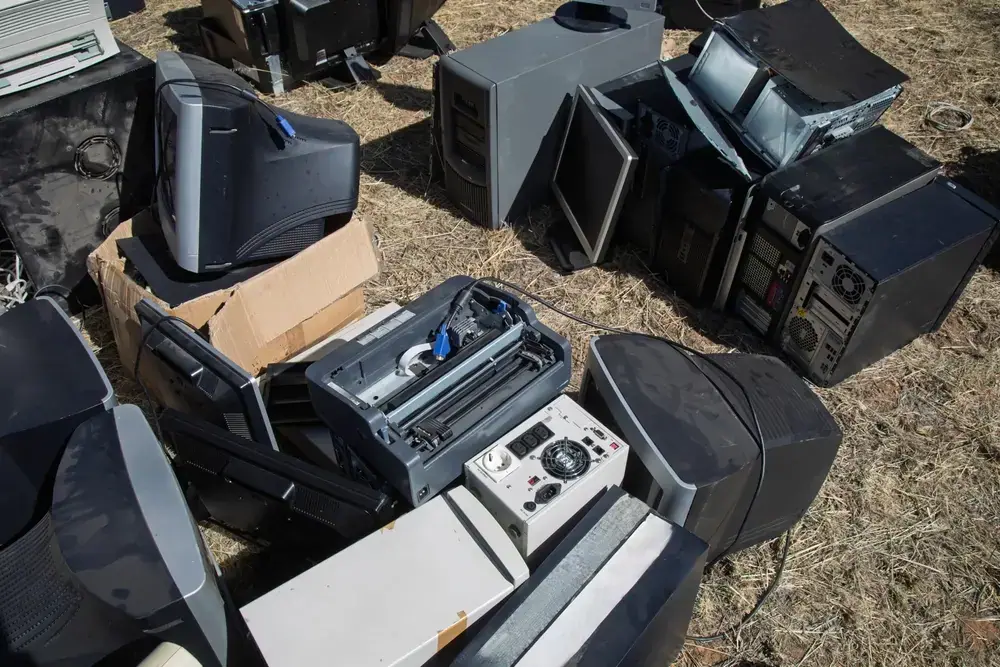
There is a drawer in the kitchen with four old phones in it. A desktop tower from a decade ago sits in the garage. The big TV that stopped turning on is leaning against the wall of the spare room because the trash company will not take it and you are not sure who will. That pile is e-waste, and in California none of it can go in the garbage cart.
The good news is that getting rid of it is easy once you know the routes. This guide covers why the rules exist, the free county drop-offs, the retailer programs, where to donate working devices, and where a junk removal services pickup fits: a bulky TV or a few electronics riding along with a bigger cleanout. Sacramento County and the state do most of the work on e-waste. We cover the gap.
What is E-Waste and Why is it a Problem?
E-waste is any discarded device with a plug or a battery, from a refrigerator or washing machine down to a cell phone, tablet or remote control. The problem is that it holds hazardous materials and valuable ones at the same time. A monitor in a landfill poisons the ground and wastes the metal inside it.
The Hidden Dangers in Your Electronics
Most devices contain at least one of these:
- Lead: in the cathode ray tubes (CRTs) of older TVs and monitors, and in the solder on circuit boards. A potent neurotoxin, worst for children.
- Mercury: in flat-screen displays, laptops and fluorescent bulbs. It damages the brain, kidneys and nervous system.
- Cadmium: in rechargeable batteries and some semiconductors. A known carcinogen that builds up in the body.
- Brominated flame retardants (BFRs): in plastic casings. They leach into soil and groundwater and disrupt hormones in people and wildlife.
In a landfill those substances seep into soil and the water supply. Incinerated, they go into the air. That is why California passed the Electronic Waste Recycling Act of 2003, which made it illegal to put most electronics in the regular trash.
A Treasure Trove of Valuable Materials
Circuit boards and internal components carry gold, silver, platinum and copper, and recovering them is far easier on the environment than mining. Recycling one million laptops saves the energy equivalent of a year’s electricity for more than 3,500 homes. Every recycled device is a little less mining, manufacturing and pollution.
Option 1: Sacramento County E-Waste Recycling Programs
The county gives residents several free ways to recycle e-waste, built so the hazardous parts are handled safely.
Official Collection Facilities
These are the most reliable places to take unwanted electronics:
- Sacramento Recycling and Transfer Station (SRTS): on Fruitridge Road, the primary drop-off point for Sacramento residents. Computers, TVs, printers, microwaves and more.
- Kiefer Landfill: a landfill with a dedicated e-waste recycling area, the convenient choice for the eastern part of the county.
- North Area Recovery Station (NARS): free e-waste drop-off for the northern Sacramento area.
If you have a lot of e-waste, these are the right destination. If you are already booking same-day junk removal for a household cleanout, a bulky TV or a few devices can simply go with the load.
Before you go:
- Check hours and accepted items: the facility’s website or a phone call confirms what they take that day.
- Proof of residency: some locations ask for it before the free service applies.
- Data security: wipe personal data first. Delete files, log out of accounts, run a factory reset.
Community E-Waste Collection Events
Cities and community groups around Sacramento host one-day e-waste events through the year, usually in a school parking lot or at a community center, so drop-off takes minutes.
- How to find them: the City of Sacramento website, your waste provider, or nonprofits like the Sacramento Regional Conservation Corps. Cities like Roseville, Folsom and Elk Grove post them on their official websites and social media.
- Why bother: if the e-waste has been piling up for a while, one event clears all of it in one trip.
Option 2: Retailer Take-Back and Recycling Programs
Major electronics retailers run in-store recycling, often free and regardless of where you bought the device. For small electronics it is the most convenient route there is.
Major Retailers with Programs
- Best Buy: one of the most comprehensive programs. TVs (for a small fee), computers, phones, cables and more, typically up to three items per household per day.
- Staples: free tech recycling for laptops, printers, monitors and phones, with rewards points for some items like ink and toner cartridges.
- Apple: the Trade-In program gives credit toward a purchase or an Apple Gift Card for eligible devices, and recycles ineligible ones for free.
For residents in Citrus Heights or Rancho Cordova, where these stores are close by, e-waste can ride along on a regular shopping trip. A bulky TV that is part of a bigger cleanout is a different matter; a junk removal crew carries it out with the rest of the load.
Option 3: Donating Functional Electronics
If the device still works, recycling is not the only option. The laptop that feels slow to you may be exactly what a student or a nonprofit needs.
Where to Donate Electronics in Sacramento
Before donating, make sure the device works, is clean, and comes with its charger and cables. Wipe your data first.
- Sacramento Public Library: sometimes accepts tablets or laptops for lending programs and digital literacy work.
- Goodwill and Salvation Army: working TVs, computers and small appliances, sold in their thrift stores to fund their programs.
- Local schools and nonprofits: classrooms and community centers often need computers, tablets or monitors.
- Sacramento Food Bank & Family Services: occasionally accepts electronics for families getting back on their feet.
Reuse beats recycling for the environment. Call ahead to confirm they are currently taking electronics, and if the item is too big to transport yourself, ask whether the charity offers pickup.
Option 4: Adding Electronics to a Junk Removal Pickup
This is the route for the old big-screen TV, or the handful of devices mixed into a garage or whole-house cleanout. If you have a large amount of e-waste or an office full of old computers, skip this option and go to an e-waste recycler directly.
What Take Care Junk Does With Electronics
Our Sacramento crew takes a few electronics alongside a regular junk pickup and drops them at an e-waste recycler. We are not an e-waste company. We do not take commercial lots of computers or office electronics; a business clearing out equipment should contact an e-waste recycler directly.
- We do the carrying: upstairs, basement or garage, the crew brings the electronics out and loads them.
- It is quick: the pickup itself takes minutes, and same-day or next-day appointments are usually available across the Sacramento area.
- Responsible drop-off: electronics cannot legally go to a landfill in California, so the few items we pick up go to an e-waste recycler. We do not wipe hard drives or destroy data, so erase your devices first.
- Everything in one trip: old furniture, appliances and general clutter go on the same truck. Useful during a renovation, an office cleanout or a move.
That is how most of our electronics pickups happen, as one line in a bigger job. A Yelp reviewer described a typical one:
“Serge responded immediately and took everything I asked him to take without hassle the same day. Great price and super easy to work with. 10/10 would recommend. Thanks again!!”
Marcus B., YelpWhen is a Junk Removal Service the Best Choice?
- Bulky or heavy items: an old CRT television or a large office copier is awkward and risky to move alone.
- Part of a bigger cleanout: a few electronics mixed in with furniture and household junk go in one pickup. Years of accumulated e-waste, or an entire office of equipment, go to an e-waste recycler directly.
- No transportation: if nothing you own fits the item, the pickup solves it.
- Your time: the cost of a pickup is often less than the time and effort of making the trips yourself.
Short version: a few electronics inside a larger cleanout, call a hauler. A lot of e-waste, use the county facilities or an e-waste recycler.
A Special Note on Data Security
Whichever route you choose, your computer, phone and tablet hold passwords, financial details, photos and personal documents. Deleting files does not permanently erase them.
How to Securely Wipe Your Devices
- Back up your data: copy anything you want to keep to an external drive, a new device or a cloud service.
- Log out of all accounts: email, social media, cloud storage, every account.
- Perform a factory reset: the step that matters. It erases your data and returns the device to its original settings:
- Windows PC: Settings > Update & Security > Recovery > Reset this PC.
- Mac: depends on the macOS version, but generally reboot into Recovery Mode and use Disk Utility to erase the drive.
- iPhone/iPad: Settings > General > Transfer or Reset iPhone > Erase All Content and Settings.
- Android: Settings > System > Reset options > Erase all data (factory reset).
- Remove SIM and memory cards: pull the SIM card and any microSD or other external memory card.
Nine Electronics You Cannot Put in the Trash
Under California’s Electronic Waste Recycling Act (SB 20) and related rules, most electronics are banned from the trash, and fines for illegal disposal can run up to $25,000 per incident. The items that trip people up most:
- TVs and monitors, the most regulated category; see our TV removal and recycling service.
- Computers and laptops, whose circuit boards contain lead, mercury and cadmium.
- Printers and copiers, which cannot go in trash or curbside recycling.
- Cell phones and tablets, small but still e-waste.
- Batteries, all of them; lithium-ion batteries are now the leading cause of fires at California waste facilities.
- Fluorescent tubes and CFLs, classified as universal waste.
- Small kitchen electronics such as microwaves and toaster ovens, because they contain circuit boards and wiring.
- Gaming consoles and accessories.
- Smart home devices, which also need their data wiped before they leave the house.
Free drop-off options include the Sacramento County household hazardous waste facility on Roseville Road and the Best Buy stores in Arden, Natomas, Folsom and Roseville, which take TVs, computers, phones and small electronics. Items that are hazardous rather than electronic are on our what we don’t take page. Businesses closing an office should read office cleanouts for data destruction, and what happens to e-waste covers what the recycler does next.
Making the Right Choice for Your E-Waste
- Free and DIY: if you can transport it, use Sacramento County’s official collection facilities or watch for a community collection event. If the item is too bulky to move, a pickup covers that.
- Small items, maximum convenience: phones and cables go to the retailer take-back programs at Best Buy or Staples.
- Working devices: donate them.
- Electronics inside a bigger cleanout: a bulky TV or a few devices ride along on the junk removal pickup and get dropped at an e-waste recycler instead of a landfill. Most people who price it find the pickup is worth it against the trips they would otherwise make.
Once you know the routes, e-waste is a short errand, not a chore. You comply with California law, keep the toxic parts out of the ground, and the metal gets used again. The next time you upgrade, you will know exactly what to do with the old device.


