

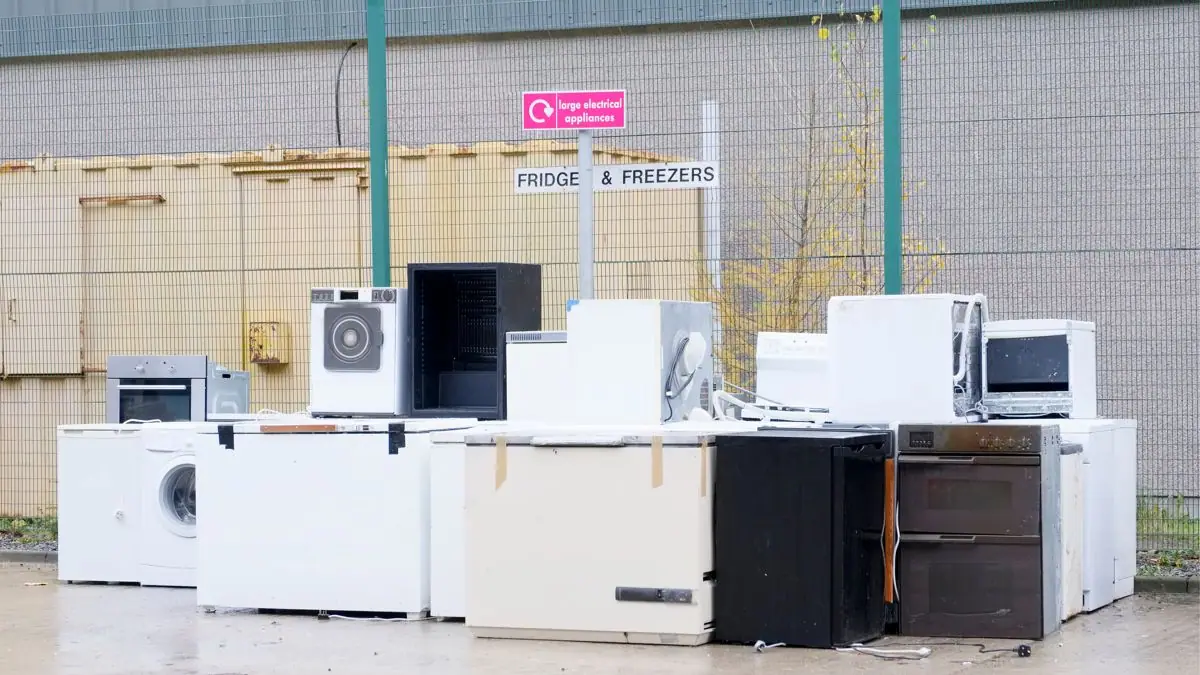
The refrigerator stopped humming sometime Tuesday night. By Wednesday the milk is warm, the new one is ordered, and a 300-pound box of steel, foam and refrigerant is standing in the kitchen with nowhere to go. It will not fit in the trash can. It should not go to the dump either, and not only because the dump is a long drive.
Old refrigerators, washers, dryers and stoves, the “white goods,” are the most awkward things a homeowner ever has to get rid of. They are also one of the most recyclable: about 75% steel by weight, plus copper, aluminum, plastic and glass. Sent to a landfill, they take up space forever and leak hazardous substances into soil and groundwater. Sent to a recycler, almost all of it comes back as raw material. This is what happens between your kitchen and that recycler: the de-pollution step, the shredder, the magnets, and where each piece ends up.
Why Appliance Recycling is Essential
Recycling major appliances is not only about clearing the garage. The environmental and economic case is unusually strong.
The Problem with Landfilling Appliances
- Space Consumption: appliances do not compact. Burying something that is over 90% recyclable in a finite landfill is pure waste.
- Environmental Contamination: the real concern. Refrigerators and air conditioners hold refrigerants (CFCs, HCFCs or HFCs), potent greenhouse gases that damage the ozone layer. Older units may contain mercury switches, freezer lights contain mercury vapor, and capacitors in appliances made before 1979 often contain polychlorinated biphenyls (PCBs), which are highly toxic and persist for decades. In a rusting landfill carcass, all of it eventually leaks.
- Wasted Resources: a typical appliance is about 75% steel, with aluminum, copper, plastic and glass making up the rest. Mining and smelting virgin ore to replace that metal takes enormous energy; recycling it takes a fraction.
The Benefits of Responsible Recycling
- Resource Conservation: recycling the steel from one refrigerator saves enough energy to power an average home for several months, and spares the iron ore, bauxite and copper that would otherwise be mined.
- Pollution Prevention: refrigerants, mercury and PCBs are captured and handled under federal and state rules instead of escaping.
- Greenhouse Gas Reduction: reclaiming or destroying ozone-depleting refrigerant is one of the biggest climate actions a single household can take.
- Economic Activity: collection, trucking, processing and remanufacturing are jobs, and scrap steel is a commodity with a price.
In a town like Davis, where residents ask where every load goes, this is the answer they want to hear.
The Appliance Recycling Lifecycle: A Step-by-Step Journey
Four stages, in order: collection, de-pollution, shredding, separation. It starts at your door.
Step 1: Collection and Transportation
A refrigerator cannot ride with the weekly trash. Its size, weight and hazardous parts mean it needs its own trip.
The Challenge for Homeowners
A refrigerator can weigh over 300 pounds, and a washer is not far behind. Getting one through a doorway and down a step without hurting yourself or the floor is a two-person job with a dolly and straps. Then it needs a truck or trailer and a drive to a facility that may be miles away. For most people that is the part that never happens, which is how a dead fridge ends up living in the garage for three years.
The Professional Solution: Junk Removal
This is the part we do. A single appliance is a minimum load, $99 to $150, confirmed before we lift it, and most days we come the same day you text.
- Convenience: point at it. Basement, upstairs laundry room, tight kitchen: we figure out the safest path out.
- Safety: dollies, straps and practice, so floors, walls and door frames stay intact.
- Responsible Routing: appliances go to a local appliance or scrap metal recycler, where a certified technician recovers the refrigerant before anything is crushed.
One honest limit: we do not disconnect gas, water or electrical lines. Have the unit unhooked (a licensed plumber or electrician for gas and hard-wired units) and we take it from there.
“They took my mini grand piano out of my house with no problem! Quick, easy and without any problems!”
Ciara Rose, GoogleFrom the truck, the appliance goes to a recycling facility and the de-manufacturing starts.
Step 2: De-Pollution and Hazardous Material Removal
The most important stage for the environment. Before any shredding, certified technicians remove every hazardous material. The industry calls it “de-pollution.”
Refrigerant Recovery
For refrigerators, freezers and air conditioners, refrigerant and compressor oil come out first.
- The Process: a technician taps the sealed cooling system, connects hoses and a recovery machine, and pumps the refrigerant out of the coils and compressor into a certified recovery tank. This “evacuation” has to be done carefully so none of the gas escapes.
- The Materials: recovered refrigerant (Freon, for example) is either filtered and reclaimed for use in older systems or destroyed by high-temperature incineration at a specialized facility. Compressor oil is drained and sent for recycling or proper disposal.
Mercury Switch Removal
Older chest freezers and washing machines often have a small mercury switch, typically the one that turns on a light when the lid opens.
- The Danger: mercury is a potent neurotoxin. Crushed in a shredder, a switch releases mercury vapor that can contaminate a large area.
- The Process: technicians know where the switches sit. They remove the small glass ampule, seal it in a dedicated container, and ship it to a mercury recycling facility.
PCB Capacitor Removal
Appliances built before 1979, and some as late as the early 1990s, often have capacitors that use polychlorinated biphenyls (PCBs) as an insulating fluid.
- The Danger: PCBs are a probable human carcinogen and extremely persistent. The EPA banned them, but they are still inside plenty of old appliances in service.
- The Process: a technician inspects for older-style capacitors. Any suspect capacitor is removed, placed in a leak-proof container, and manifested as hazardous waste for a specialized high-temperature incinerator.
Only after this does the appliance move on to the loud part.
Step 3: Shredding and Granulation
With the hazards gone, the shell is broken down to liberate its core materials.
The Main Shredder
A crane or grapple drops the carcass onto a conveyor feeding an industrial shredder, usually a hammer mill. Dozens of heavy rotating steel hammers tear the appliance into fist-sized pieces in seconds, and the violence does the first sorting: steel frame, plastic liner, copper wiring and insulation foam come apart from each other. The output is a mixed stream called “fluff” or shredder residue, and the next stage sorts it into pure commodities.
Step 4: Material Separation and Recovery
The shredded mix passes through a series of separators, each built to pull one material.
Magnetic Separation for Steel
Steel comes out first, under a rotating magnetic drum the size of a room.
- How it works: ferrous metal (iron and steel) is lifted off the main belt by the magnet and dropped onto its own conveyor as a clean stream of shredded steel.
- The Result: steel is 70-80% of an appliance’s weight, and the scrap is baled and shipped to steel mills to become new car parts and building material. That is a familiar sight around the industrial yards of West Sacramento.
Eddy Current Separation for Non-Ferrous Metals
- How it works: a fast-spinning rotor with strong magnets induces an electric current (an “eddy current”) in conductive non-ferrous metals like aluminum and copper. That current creates its own magnetic field, which repels the metal and kicks the pieces off the belt into a separate bin.
- The Result: aluminum and copper are separated from the plastic and foam, baled, and sold to smelters.
Air and Water Separation for Plastics and Foam
What is left is plastic, glass, insulation foam and other light material.
- Air Classification: jets of air blow light foam away from heavier, dense plastics.
- Sink-Float Tanks: dropped into water, different plastic resins sink or float by density, which separates them.
- The Result: recovered plastic becomes decking, automotive parts and outdoor furniture. The leftover foam and non-recyclable residue go to a landfill, but at a fraction of the original volume and with every hazardous material already removed.
At the end of the line, one bulky appliance has become bales of steel, aluminum, copper and plastic headed back into manufacturing.
What You Can Do: A Simple Plan for Responsible Disposal
None of the above happens unless the appliance reaches a recycler. That first step is yours.
1. Don’t Dump It Illegally
Never leave an appliance on a roadside, in a vacant lot or in the woods. It is illegal, it is ugly, and it guarantees the refrigerant and mercury inside end up in the ground. Cities like Roseville and Folsom enforce strict illegal dumping ordinances.
2. Check for Bounty Programs
Some utilities and cities pay a small bounty, around $25-$50, to collect an old working refrigerator or freezer, because getting inefficient units off the grid saves energy. Locally, SMUD periodically offers free pickup and a rebate up to $50 for a working fridge or freezer; check smud.org, because it is not always open. If you are buying a replacement, most big retailers haul the old unit away at delivery, usually for $25 to $50, though they will not disconnect gas.
3. The Easiest Option: Call the Professionals
For almost everyone, the simplest safe route is a pickup. Appliance removal is one of our core services.
- Simple Scheduling: book online or by phone, with the price settled before we begin.
- Full-Service Removal: once the water, gas and power lines are disconnected, we work it out of the house and onto the truck.
- Eco-Friendly Disposal: the appliance goes to a local recycler, where a certified technician recovers the refrigerant before the metal is recycled. A working unit in clean condition goes to a Sacramento charity when one will take it.
A new appliance should be the good part of the week. If the old one is in the way, contact us or text a photo to (916) 770-7619 and it is usually gone the same day.


