

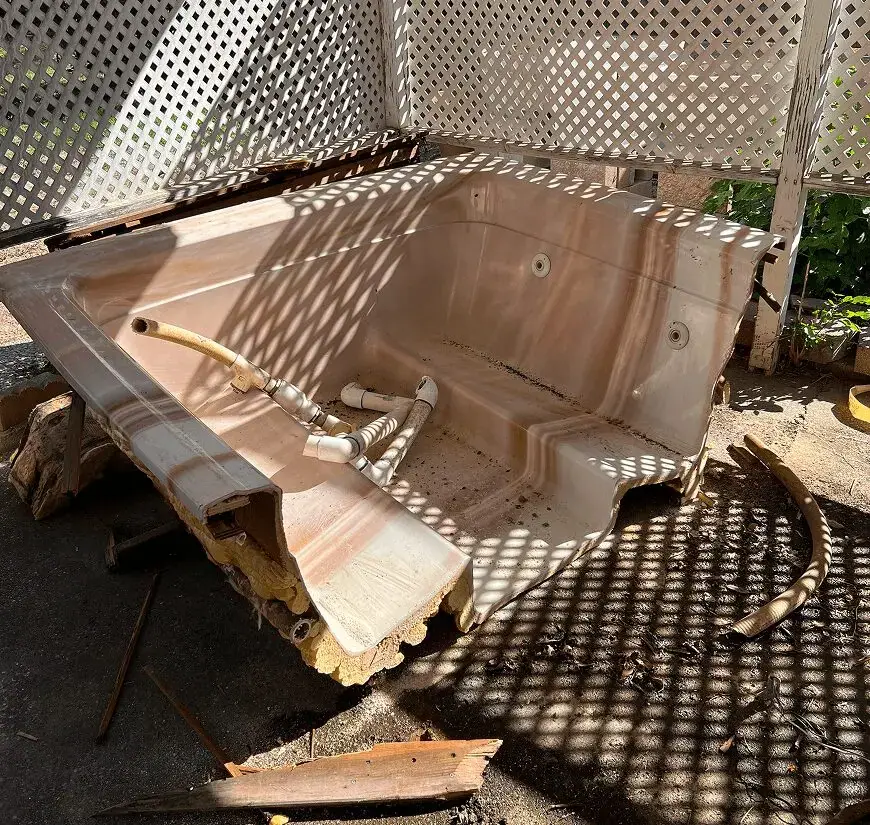
The last board came up on Saturday afternoon. Now there is a pile the size of a parked car in the backyard: splintered planks, 4x4 posts, joists full of rusted screws, and a few boards that are still perfectly solid. The new deck cannot go in until that pile is gone, and nothing about it fits in a trash cart.
The short answer: old deck wood disposal depends on what the wood is. Pressure-treated boards and posts are “treated wood waste” under California law: they cannot go in your garbage or green cart, cannot be burned, and in Sacramento County go to Kiefer Landfill, the only county facility that accepts them. Clean, unpainted cedar or redwood can be recycled as clean wood. Solid boards can be reused.
Old deck wood cannot go in the weekly bin, and the city will not collect it from the curb. It is heavy, bulky, and usually soaked in chemical treatments that dictate its disposal. This guide covers how to tell what your deck is made of, the California rules for treated wood, why it must never be burned, how to sort the boards worth keeping, ways to repurpose them, and exactly where the rest can go in the Sacramento area. Rules and fees below were checked against the state and county pages on November 20, 2026.
Understanding Your Deck Material
The species and the treatment decide your whole disposal strategy, so identify the wood before you plan anything.
How to Tell if Your Deck Wood Is Pressure-Treated
California’s Department of Toxic Substances Control (DTSC) lists the signs to look for on its treated wood waste page:
- Small indentations across the surface, left by the treatment process.
- Staining only around the edge when you cut a board, with lighter wood in the middle.
- A green or dark brown tint, even on weathered boards.
- An end tag stapled to the board naming the preservative and the use it was rated for (ground contact, above ground).
Posts set in concrete or soil, the joists and the ledger are almost always treated, even when the deck boards on top are cedar or redwood. Sort them as treated.
Pressure-Treated Wood Hazards (CCA and ACQ)
Most suburban decks built in the last 40 years use pressure-treated pine, injected with chemicals against rot, insects and constant moisture. DTSC names the preservatives that make it a concern: arsenic, chromium, copper, pentachlorophenol and creosote.
For decades the standard treatment was Chromated Copper Arsenate (CCA), which contains arsenic. According to the EPA, manufacturers voluntarily stopped making CCA-treated wood for homeowner uses in December 2003, and before 2004 it was used in residential decks and playsets, so a deck built before 2004 is very likely CCA lumber. Newer pressure-treated wood uses Alkaline Copper Quaternary (ACQ) or Copper Azole: no arsenic, but still heavy copper and fungicides. Either way, pressure-treated wood cannot be recycled into mulch or compost, because the chemicals can leach into soil, surface water and groundwater.
Cedar and Redwood (Natural Woods)
A deep, rich color and natural insect resistance usually mean cedar or redwood. These woods resist rot on their own, with no chemical injection, so they hold real repurposing value and untreated natural woods are highly recyclable. Facilities chip clean boards into landscaping mulch or biomass fuel. The catch: paint, stain, oil or a sealer from a previous owner takes away that clean recycling status. Sacramento County’s facilities require oiled, stained, painted or treated wood to be pulled out of any clean wood load.
California Rules for Treated Wood Waste
California treats old pressure-treated lumber as a potential hazardous waste. Under the alternative management standards adopted by Assembly Bill 332 in 2021 and codified at Health and Safety Code section 25230, treated wood waste may be shipped without a hazardous waste manifest or a hazardous waste hauler and disposed of at specific landfills approved to accept it, instead of going to a hazardous waste facility. What that means for a homeowner in Sacramento:
- Not in any curbside cart. The City of Sacramento’s treated wood waste page says it does not accept treated wood waste in garbage or organics collection or in its Household Junk Pickup, and lists decking, patio posts, fence posts, landscape timbers and railroad ties as examples.
- Not in a bulky pickup. Unincorporated Sacramento County’s bulky waste pickup also refuses treated wood waste, including decking.
- Only at an approved landfill. In Sacramento County that is Kiefer Landfill. The North Area Recovery Station does not take it.
- Big jobs have paperwork. Anyone who generates more than 10,000 pounds of treated wood waste in a calendar year must notify DTSC within 30 days. A single home deck is rarely that heavy, but a contractor tearing out several can reach it.
The Golden Rule: Never Burn Treated Wood
A big pile of scrap lumber next to a fire pit is tempting. It is the worst option on the list.
Burning pressure-treated wood is dangerous and, outdoors at a home, illegal in California: the state Air Resources Board’s rule on residential waste burning prohibits burning household waste other than vegetation, and specifically excludes chemically treated lumber from what counts as vegetation. Fire does not destroy the arsenic in CCA wood; it sends it into the smoke and concentrates it in the ash. When that ash blows into the vegetable bed or washes into the ground, it carries the same chemicals with it. The EPA’s advice on CCA wood is plain: do not burn it or other preservative-treated wood in a residential setting. Never burn old deck wood in a fire pit, a fireplace or a wood stove, for any reason.
How to Sort Salvageable Planks from Rotted Ones
A worn-out deck is not all garbage. Sorting the pile saves good lumber for the next project and cuts the weight of the waste you have to haul.
The Screwdriver Test
Rot is the main enemy, and a board can look sound outside while it is mush inside. Press a flathead screwdriver firmly into the wood at the board ends, around the screw holes, and along the joists underneath. If it sinks in easily or the wood flakes like wet cardboard, the board is rotted, has no strength, and goes in the disposal pile. If the wood pushes back and feels solid, it is probably worth saving.
Inspecting for Warps, Splits, and Splinters
A board that passes the rot test can still be useless. Sight down the length of each one:
- Bowing and cupping: a board curved like a smile or bowed hard to one side will never lie flat in a build.
- Deep splits: a crack running all the way through takes the strength with it.
- Heavy splintering: gouged and splintered past what a sanding fixes belongs in the disposal pile.
Stack the solid, straight boards somewhere dry. Everything warped, split or rotted goes in the disposal pile, and keep that pile in two stacks, treated and untreated, because they go to different places.
Creative Ways to Repurpose Old Deck Boards
Solid salvaged planks are free building material. Repurposing old deck wood saves a trip to the lumber aisle and keeps heavy stock out of the landfill.
Rustic Garden Planters and Raised Beds
Weathered deck boards look right in a garden. Cut the good planks down for planter boxes or raised beds, with two rules. Modern ACQ-treated wood needs a heavy plastic liner inside the box before any soil goes in, so the copper does not leach into the dirt your vegetables grow in. Pre-2004 CCA-treated wood should never go near edible plants at all; keep those older boards for decorative flower boxes, or skip them.
Outdoor Furniture and Workbenches
Deck boards are strong, so they repurpose well into a garden bench or a heavy potting station. The leftover 4x4 posts and solid planks also make a big, durable garage workbench. Wear gloves and a dust mask when you cut or sand treated wood, and sweep up the sawdust instead of leaving it in the yard.
Walkways and Landscaping Borders
Shorter solid pieces define space. Cut them to uniform lengths for a border around flower beds, or lay planks flat over a gravel bed for a rustic walkway through the garden.
Where to Dispose of Old Deck Wood in Sacramento
Even after salvaging, a big pile of rotted, warped and unusable wood remains. Where it goes depends on what it is. Here is where each part of an old deck can go, with the county’s 2026 fees:
| Material | Where it can go | 2026 cost |
|---|---|---|
| Pressure-treated boards, posts, joists | Kiefer Landfill only (treated wood waste) | $144.90 per ton |
| Clean, unpainted cedar or redwood | Kiefer or North Area Recovery Station clean wood area | $115.65 per ton |
| Clean lumber, sorted by itself | GreenWaste Florin Perkins, 4201 Florin Perkins Rd. | Call for current price |
| Painted or stained boards | Pulled out of clean wood; ask the scale house | Varies |
| Screws, nails, joist hangers | Clean metal at Kiefer or North Area | No fee |
Kiefer Landfill for Treated Wood
Kiefer Landfill, at 12701 Kiefer Blvd. in Sloughhouse, is open 6:30 a.m. to 4:30 p.m. on weekdays and 8:30 a.m. to 4:30 p.m. on weekends, and you do not have to live in Sacramento County to use it. Treated wood waste is charged as a hard-to-handle material at $144.90 per ton under the 2026 Kiefer fee schedule, prorated, with a $45 minimum on weighed loads. Cover or tie down the load (the county adds $25 for an uncovered one) and expect the scale house to ask what you are carrying.
Clean Wood Recycling
Untreated cedar or redwood has better options. Both county facilities, Kiefer and the North Area Recovery Station at 4450 Roseville Road in North Highlands, have a green waste and clean wood area for composting, at $115.65 per ton on weighed loads. GreenWaste’s Florin Perkins facility recycles source-separated lumber and fencing with small amounts of nails or hinges, but takes no painted or treated wood. Pull every rusted screw, hidden nail and metal joist hanger first; clean metal is free to drop at the county sites.
Self-hauling means renting a truck or trailer, loading boards that weigh far more than they look, and making two stops if the pile is mixed. That is often where hiring it out starts to make sense.
Why Professional Debris Removal Makes Sense
Moving deck demolition debris is grueling and a little dangerous. Hundreds of pounds of splintered, nail-studded lumber across a yard wears a person out fast, and one wrong move is a pulled back or a puncture from a rusty screw. Add the truck rental, the gas and the county dump fees and self-hauling often costs more than hiring it out.
A hauling crew arrives with the right truck, loads the heavy lumber quickly, sweeps the yard for stray nails, and takes the debris to the correct facility: treated wood to a landfill that accepts it, and a load of clean, untreated wood to a wood recycler. One note on what we take: a single-material load (wood only) is a normal job for us; mixed demolition debris with drywall, tile or roofing needs a licensed C&D hauler or a debris dumpster. If the deck came out with a hot tub on it, our hot tub removal guide covers that part.
“Serge did an excellent job at removing an old hot tub and a deck. He was pleasant to work with, worked efficiently, cleaned up the job site, and his prices were reasonable.”
James Rucks, GoogleLocal Help for Deck Wood Removal
We clear deck debris for homeowners across Sacramento and the surrounding communities, loading, hauling and disposing of it so you skip the dump runs, the sharp debris and the disposal rules. Deck wood is heavy, so weight sets the price more than volume does. Our pricing guide shows the load tiers; text a photo of the pile to (916) 770-7619 and we confirm the number before we load. Old fence boards from the same project? See old fence disposal; they follow the same treated and untreated split.
Frequently Asked Questions
How do I dispose of old pressure-treated deck boards in California?
Keep them out of every curbside cart and every fire. Treated wood waste goes to a landfill approved to accept it; in Sacramento County that is Kiefer Landfill, where it costs $144.90 per ton in 2026. Separate it from clean wood before you arrive.
Can pressure-treated wood go in yard waste or the green bin?
No. The City of Sacramento does not accept treated wood in organics collection, and the county requires treated wood to be removed from any green waste or clean wood load, because the preservatives contaminate compost.
Can you burn old decking boards?
Not treated ones. California’s residential burning rule bans burning household waste other than vegetation and excludes chemically treated lumber, and burning CCA wood leaves arsenic in the smoke and ash. Untreated scraps belong in clean wood recycling, not the fire pit either.
Can I throw wood planks in the garbage?
Not treated boards: no garbage, recycling or organics cart in the Sacramento area takes them. Untreated lumber is easier. City of Sacramento customers can set it out at a household junk appointment if it is cut to 6 feet or less, and county residents can include clean lumber up to 4 inches wide and 5 feet long in their bulky waste pickup, kept separate from treated wood.
How can I dispose of deck wood for free?
Give the solid boards away for reuse, and use a household junk appointment for untreated lumber if you are a City of Sacramento customer (two free appointments a year, February to October). There is no free route for treated wood; it is a paid drop-off at Kiefer.
Reclaim Your Backyard Today
Tearing out an old deck makes the backyard safer and better looking, and it produces a startling amount of heavy, chemically treated waste. Know what the wood is, never burn it, salvage the solid boards for beds and benches, send clean wood to a recycler, and get the treated wood to Kiefer. When the pile of rotted boards and rusted nails is more than you want to touch, contact us and we will clear it so the new deck can go in.


